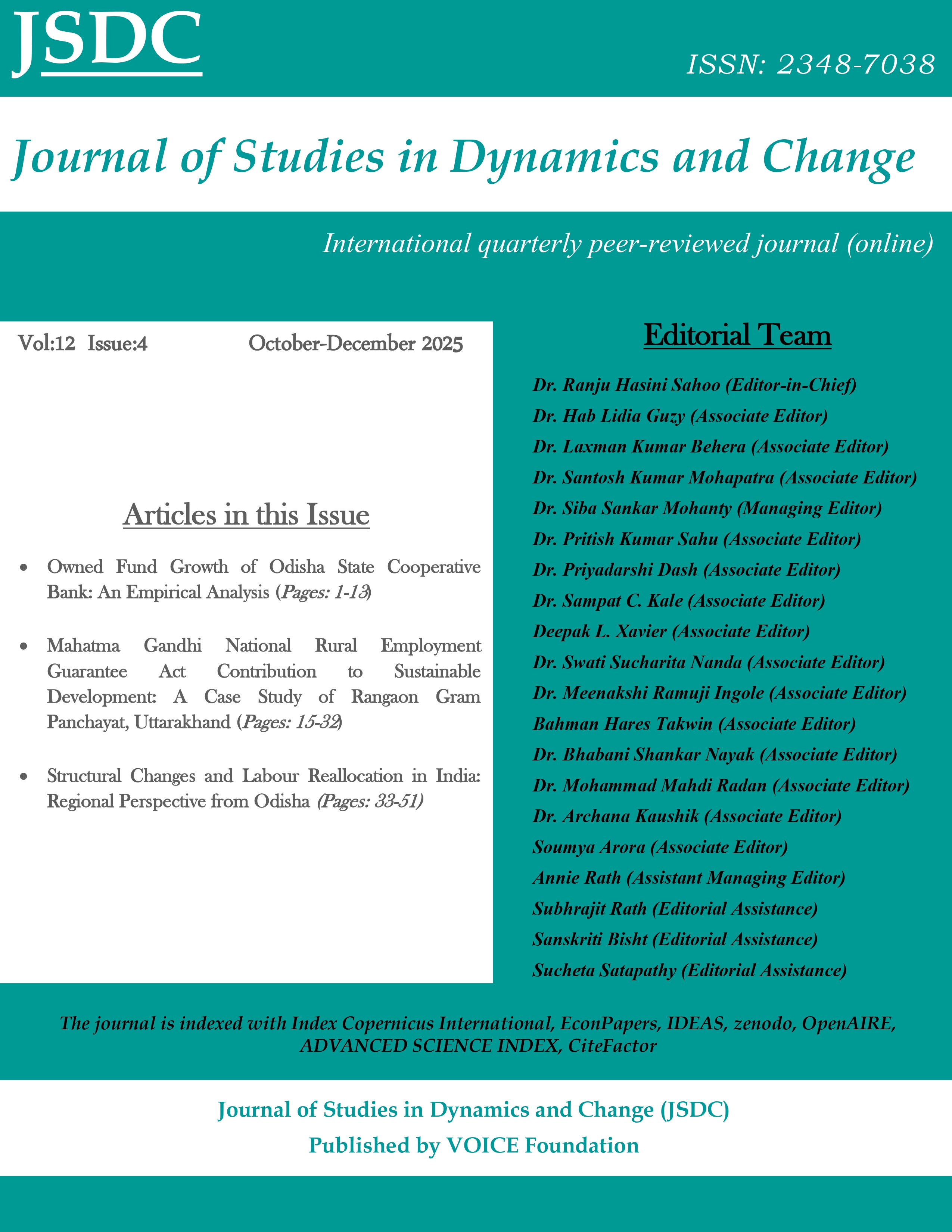
Structural Changes and Labour Reallocation in India
Regional Perspective from Odisha
Keywords:
Structural changes, Economic growth, GDP, Labour reallocation, EmploymentAbstract
Structural changes in an economy drive labour reallocation across sectors, influencing productivity, employment patterns, and economic growth. In developing regions, this transition often begins with a shift from agriculture to manufacturing and services, followed by a growing dominance of the service sector. This paper examines how structural change has shaped labour reallocation in Odisha’s economy over the past three decades (1991–2021) in comparison with India. Using the Michaely index, the study measures the extent of sectoral shifts, while a decomposition analysis explores the relationship between structural transformation, economic growth, and employment. The findings reveal that structural change has been a weak driver of economic growth in both regions, with a similarly sluggish impact on employment conditions. This study seeks to guide policymakers in crafting strategies that not only foster structural change but also enhance economic growth and expand employment opportunities in the region.
References
Amirapu, A., & Subramanian, A. (2015). Manufacturing or services? An Indian illustration of a development dilemma. Center for Global Development Working Paper, (408).
Boora, G., & Bishnoi, N. K. (2020). Economic Growth and Structural Change-Analysis for The State of Haryana, 1993-94 To 2017-18. International Journal of Management (IJM), 11(11).
Bosworth, B., & Collins, S. M. (2008). Accounting for growth: Comparing China and India. Journal of Economic Perspectives, 22(1), 45–66.
Clark, C. (1940). The conditions of economic progress. Macmillan.
Das, A., & Satyananda, A. (2016). Mining and Odisha’s economy. The Economy of Odisha: A Profile” (eds) S C. Panda, PB Nayak and P. Pattnaik. Oxford University Press, New Delhi.
Dietrich, A. (2012). Does growth cause structural change, or is it the other way round?: A dynamic panel data analyses for seven OECD countries. Empirical Economics 43, 915944.
Dholakia, R. H., & Sapre, A. A. (2011). Estimating structural breaks endogenously in India’s post-independence growth path: An empirical critique. Journal of Quantitative Economics, 9, 73-87.
Ghose, A. K. (2019). Economic development in China and India: A tale of great divergence. Delhi: Institute for Human Development.
Ghose, A. K. (2020). Structural transformation of India’s economy. Institute for Human Development.
Ghose, A. K. (2021). Structural change and development in India. Indian Journal of Human Development, 15(1), 7-29.
Government of Odisha. (n.d.). Mines and minerals. https://odisha.gov.in/mines-and-minerals
Government of Odisha. (2022). Odisha economic survey 2021–22. Planning & Convergence Department.
Harriss-White, B. (2020). India’s informal economy: Past, present and future. In The informal economy revisited (pp. 38-44). Routledge.
Hasan, R. (2013). Growth, structural change, and poverty reduction: Evidence from India.
Kaldor, N. (1967). Strategic factors in economic development.
Kuznets, S. S. (1966). Modern economic growth. Yale University Press.
Lewis, W. A. (1954). Economic development with unlimited supplies of labour.
Maddison, A. (1980). Economic growth and structural change in the advanced countries. Western economies in transition: Structural change and adjustment policies in industrial countries, 41-65.
Majid, N. (2019). Structural change and employment in India (Working Paper No. 1). ILO/SIDA Partnership on Employment.
Meher, S. K. (2019). Impact of distress seasonal migration from a socio-economic perspective: A case study of Nuapada District in Kalahandi Balangir Koraput Region of Odisha. The Indian journal of labour economics, 62(4), 763-782.
Michaely, M. (1962). Concentration in International Trade. North-Holland Publishing Company. Stoikov, V. (1966). Some determinants of the level of frictional unemployment: A comparative study. International Labour Review ,93, 530 49.
Mishra, D. K. (2016). Seasonal migration from Odisha: A view from the field. Internal migration in contemporary India, 263-290.
Mishra, D. K. (2020). Seasonal migration and unfree labour in globalising India: Insights from Field surveys in Odisha. The Indian Journal of Labour Economics, 63(4), 1087-1106.
McMillan, M., Rodrik, D., & Verduzco-Gallo, Í. (2014). Globalisation, structural change, and productivity growth, with an update on Africa. World development, 63, 11-32.
Nayak, C., & Kumar, C. R. (2018). Seasonal Migration and Livelihood of Marginalised Communities-ACase Study in Boudh District of Odisha. Indian Journal of Economics and Development, 14(2), 316-323.
NITI Aayog. (2021). SDG India Index & Dashboard 2020–21: Partnerships in the decade of action. Government of India. https://sdgindiaindex.niti.gov.in/assets/Files/SDG3.0_Final_04.03.2021_Web_Spreads.pdf
Parida, J. K. (2015). MGNREGS, Rural Employment and Distress Migration: A study in Odisha.
Parida, J. K. (2016). MGNREGS, distress migration and livelihood conditions: a study in Odisha. Journal of Social and Economic Development, 18, 17-39.
Stoikov, V. (1966). Some determinants of the level of frictional unemployment: a comparative study. Int'l Lab. Rev., 93, 530.
Timmer, M. P., de Vries, G. J., & de Vries, K. (2015). Patterns of structural change in developing countries. In J. Weiss & M. Tribe (Eds.), Routledge handbook of industry and development (pp. 65–83). Routledge.
Zagler, M. (2009). Economic growth, structural change, and search unemployment. Journal of Economics, 96, 63-78.
Downloads
Published
How to Cite
Issue
Section
License
Copyright (c) 2026 Journal of Studies in Dynamics and Change (JSDC)

This work is licensed under a Creative Commons Attribution-NonCommercial-ShareAlike 4.0 International License.
Readers and users of the Journal of Studies in Dynamics and Change (JSDC) are free to Share — copy and redistribute the papers published in the journal in any medium or format. However, the user (1) must give appropriate credit, provide a link to the license, and indicate if changes were made. (2) May not use the material for commercial purposes (3) Must distribute your contributions under the same license as the original if any remix, transform, or build upon the material is done.