Ethno-Ecology, Eco-System and Environmental Wisdom
Looking from Janjati Perspective
Keywords:
Ethno-Ecology, Eco-system, Environmental wisdom, Janjati communities, Forest resources, Emic-Etic perspectivesAbstract
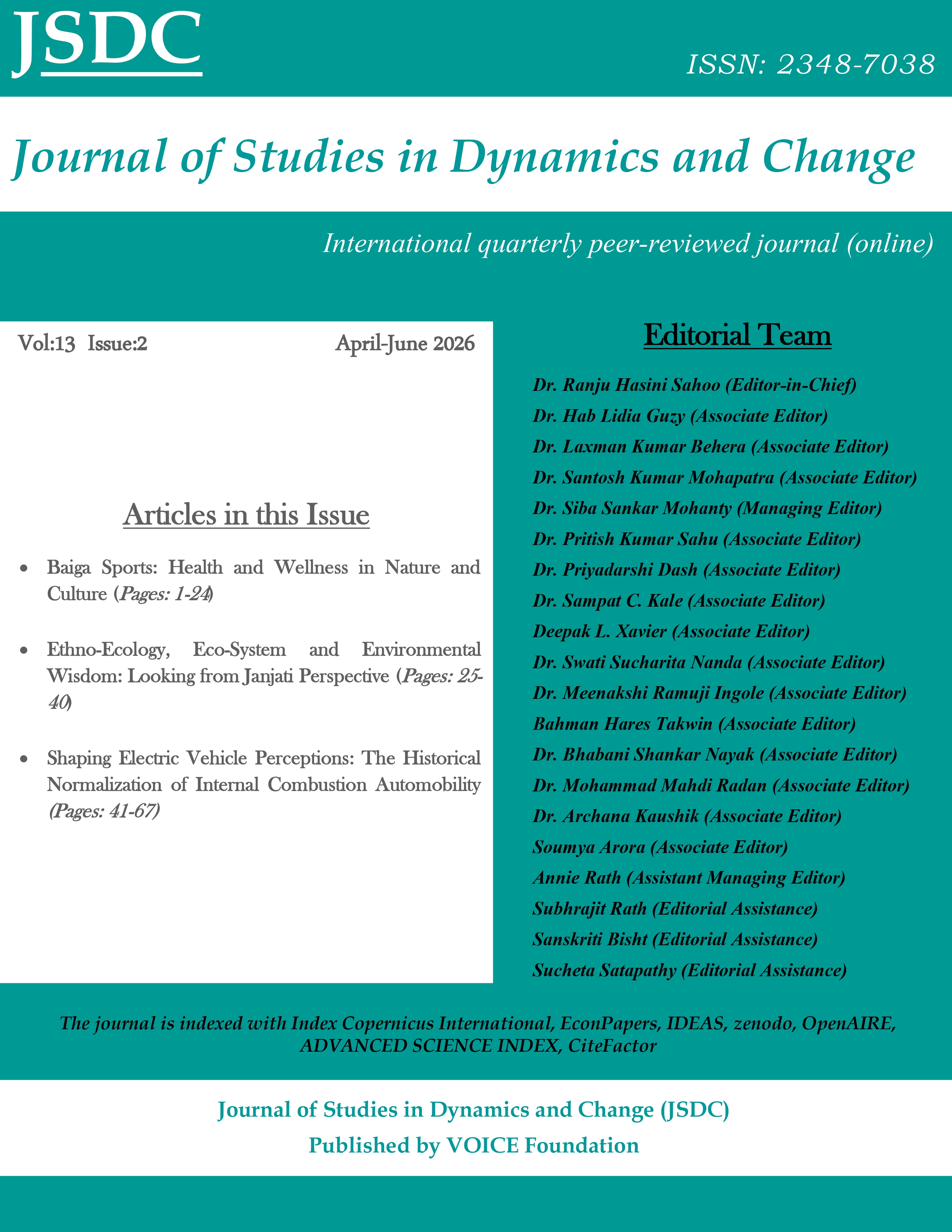
Human society from the ancient times maintains a symbiotic relationship with forest and forest-based resources which influence their life, living and source of livelihood from birth to death. The forest resources in the form of plants, animals, birds, fruits are adopted in various cultural practices in the form of totems, beliefs and customs which are considered as the environmental wisdom in which human society is an integral part of both physical and meta physical entities. Most of the concepts of environmental wisdom used as a part of environmental explanations in this field have western origin and looking from etic perspectives. The humor theory of Hippocrates considered as the important foundation for environmental determinism has its origin in the theory of ‘Panchatatva’ of Indian Philosophy includes Prithvi (Earth), Jal (Water), Agni/Tej (Fire), Vayu (Air) and Akash (Space/Ether), which are the fundamental building blocks which influences our physical and mental wellbeing. The geographic differences in the physical form and their effects on personality resulted in variations in their world by life and living. However, over the period scientific methods based on simple, linear, cause-effect relationships ignored or neglected the complex interactions and feedback processes that make environmental wisdom. However, only recently a new approach is focused to look at environmental resources and ecological relationships from participants’ point of view which is called as ethno-science, ethnographic semantics indigenous traditional knowledge systems broadly known as Environmental Wisdoms build over centuries through various coping processes which need to be understood from emic perspective. Keeping this in mind, attempt is made through empirical studies and understanding among few Janjati communities of Chhattisgarh with respect to their emic understanding of the Ethno-ecology, Eco-system, and environmental wisdom long been practiced and handed over from generation to generation as a part of the processes of cultural continuity and change.
References
Agarwal, A., & Narain, S. (1985). The state of India’s environment. Centre for Science and Environment.
Aristotle. (1984). Politics (B. Jowett, Trans.). Random House. (Original work published ca. 350 B.C.E.)
Bateson, G. (1972). Steps to an ecology of mind. Chandler.
Baviskar, A. (1995). In the belly of the river. Oxford University Press.
Berkes, F. (1999). Sacred ecology. Taylor & Francis.
Boas, F. (1896). The limitations of the comparative method of anthropology. Science, 4(103), 901–908.
Census of India. (2011). Primary census abstract data for villages of Chhattisgarh. Government of India.
Darwin, C. (1859). On the origin of species. John Murray.
Dasgupta, S. (1975). A history of Indian philosophy (Vol. 1). Motilal Banarsidass.
Dube, S. C. (1951). The Kamar. Lucknow University.
Elwin, V. (1939). The Baiga. John Murray.
Escobar, A. (2008). Territories of difference: Place, movements, life, redes. Duke University Press.
Folke, C., Carpenter, S. R., Walker, B., Scheffer, M., Chapin, T., & Rockström, J. (2010). Resilience thinking: Integrating resilience, adaptability and transformability. Ecology and Society, 15(4), 20.
Gadgil, M., & Guha, R. (1992). This fissured land: An ecological history of India. Oxford University Press.
Gadgil, M., & Vartak, V. D. (1976). Sacred groves of Western Ghats in India. Economic Botany, 30(2), 152–160.
Geertz, C. (1973). The interpretation of cultures. Basic Books.
Guha, R. (1989). The unquiet woods: Ecological change and peasant resistance in the Himalaya. Oxford University Press.
Harris, M. (1976). History and significance of the emic/etic distinction. Annual Review of Anthropology, 5, 329–350.
Hippocrates. (1956). Airs, waters, places (W. H. S. Jones, Trans.). Harvard University Press. (Original work published ca. 400 B.C.E.)
Ingold, T. (2000). The perception of the environment: Essays on livelihood, dwelling and skill. Routledge.
Kautilya. (2013). Arthashastra (L. N. Rangarajan, Trans.). Penguin. (Original work published ca. 300 B.C.E.)
Kroeber, A. L. (1939). Cultural and natural areas. University of California Press.
Netting, R. M. (1981). Balancing on an alp: Ecological change and continuity in a Swiss mountain community. Cambridge University Press.
Odum, E. P. (1971). Fundamentals of ecology. Saunders.
Ostrom, E. (1990). Governing the commons: The evolution of institutions for collective action. Cambridge University Press.
Plato. (2004). The republic (C. D. C. Reeve, Trans.). Hackett Publishing Company. (Original work published ca. 380 B.C.E.)
Radhakrishnan, S. (1953). The principal Upanishads. Allen & Unwin.
Rappaport, R. A. (1968). Pigs for the ancestors: Ritual in the ecology of a New Guinea people. Yale University Press.
Sharma, C. (2000). A critical survey of Indian philosophy. Motilal Banarsidass.
Shiva, V. (1988). Staying alive: Women, ecology and development. Kali for Women.
Steward, J. H. (1955). Theory of culture change: The methodology of multilinear evolution. University of Illinois Press.
Sundar, N. (1997). Subalterns and sovereigns: An anthropological history of Bastar, 1854–1996. Oxford University Press.
Toledo, V. M. (2002). Ethnoecology: A conceptual framework for the study of indigenous knowledge of nature. In J. R. Stepp, F. S. Wyndham, & R. K. Zarger (Eds.), Ethnobiology and biocultural diversity (pp. 511–522). International Society of Ethnobiology.
.
Downloads
Published
How to Cite
Issue
Section
License
Copyright (c) 2026 Journal of Studies in Dynamics and Change (JSDC)

This work is licensed under a Creative Commons Attribution-NonCommercial-ShareAlike 4.0 International License.
Readers and users of the Journal of Studies in Dynamics and Change (JSDC) are free to Share — copy and redistribute the papers published in the journal in any medium or format. However, the user (1) must give appropriate credit, provide a link to the license, and indicate if changes were made. (2) May not use the material for commercial purposes (3) Must distribute your contributions under the same license as the original if any remix, transform, or build upon the material is done.