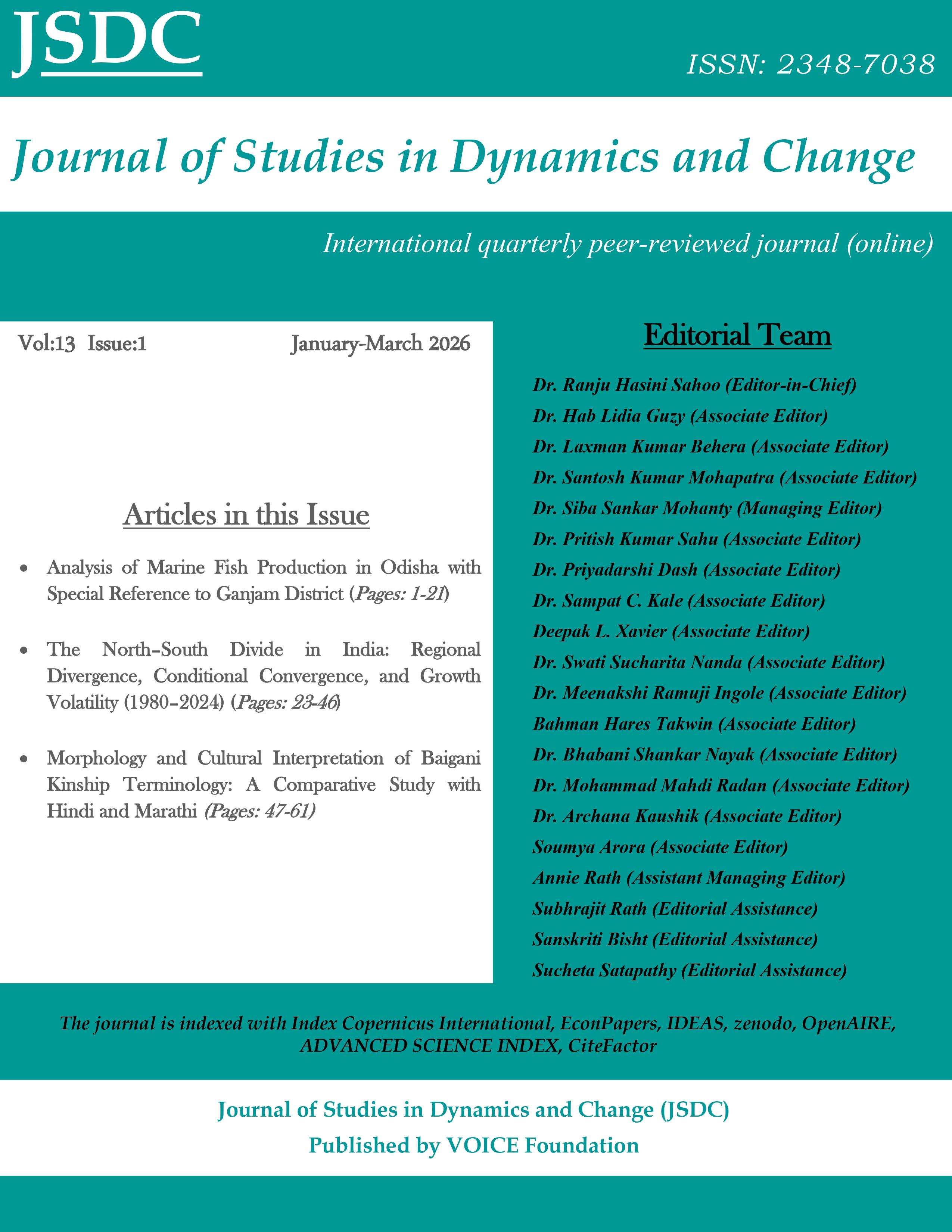
The North–South Divide in India
Regional Divergence, Conditional Convergence, and Growth Volatility (1980–2024)
Keywords:
Income inequality, Convergence, Growth volatility, Structural heterogeneity, Fiscal federalismAbstract
The idea of ‘North-South Divide’ first emerged globally in the Brandt Report (1980), which articulated a developmental boundary between the industrialised North and the agrarian South. The present study attempts to put the Indian sub-continent into this framework. Although regional income disparities have steadily increased over the last four and a half decades inciting a wide discourse of studies, a general consensus regarding the underlying dynamics of convergence across Indian states has not yet been achieved. This paper examines and compares growth trajectories of Indian states and union territories over the period of 1980 to 2024 based on Sigma Convergence, Beta Convergence (conditional and unconditional) and a Growth-Volatility Analysis. Results indicate that sigma divergence is persistent over the years, i.e., there has been a sustained increase in the dispersion of per capita income. No statistically significant evidence of unconditional beta convergence was found. This means that initial income levels alone do not explain subsequent growth performance. However, panel fixed effects estimates, that take into account time-invariant state characteristics and common shocks, revealed a statistically significant negative relation between growth and lagged income. This shows conditional convergence and hence it can be said that Indian states might be converging towards their own distinct, structurally determined steady states instead of moving towards a common national equilibrium. The growth volatility analysis fails to establish a systematic relationship between average growth and instability across states but further descriptive statistics indicate that economically stronger states mostly exhibit lower fluctuations compared to their lagging counterparts. In a nutshell, this paper puts persistent structural heterogeneity into the convergence perspective of Indian states. This has implications for policy-making as well – fiscal transfers tied to state-level metrics based on capacity building, infrastructural development and shock vulnerability reduction; shifting from a one-size-fits-all model to a differentiated model based on regional economic structure and expanding supply chains of core industries to periphery regions to infuse developmental spillover.
References
Abler, D. G., & Das, J. (1998). The determinants of the speed of convergence: The case of India. Applied Economics, 30(12), 1595–1602.
Adabar, K. (2004). Economic growth and convergence in India. Institute for Social and Economic Change.
Ahluwalia, M. S. (2000). Economic performance of states in post-reform period. Economic and Political Weekly, 35(19), 1637–1648.
Ahluwalia, M. S. (2002). State-level performance under economic reforms in India. In A. O. Krueger (Ed.), Economic policy reforms and the Indian economy (pp. 91–122). University of Chicago Press.
Akram, V., & Ali, J. (2021). Output convergence at sector level across Indian states: Evidence from weak sigma and club convergence analysis. Journal of International Development, 33(4), 728–748.
Bandyopadhyay, S. (2012). Convergence club empirics: Evidence from Indian states. Research in Applied Economics, 4(1), 1–22.
Bandyopadhyay, S. (2021). The persistence of inequality across Indian states: A time series approach. Review of Development Economics, 25(4), 2058–2075.
Barro, R. J., & Sala-i-Martin, X. (1992). Convergence. Journal of Political Economy, 100(2), 223–251.
Cashin, P., & Sahay, R. (1996). Regional economic growth and convergence in India. Finance and Development, 33, 49–52.
Cherodian, R., & Thirlwall, A. P. (2015). Regional disparities in per capita income in India: Convergence or divergence? Journal of Post Keynesian Economics, 37(3), 384–407.
Gaur, A. K. (2010). Regional disparities in economic growth: A case study of Indian states. Paper presented at the 31st General Conference of the International Association for Research in Income and Wealth.
Ghosh, M. (2008). Economic reforms, growth and regional divergence in India. Margin: The Journal of Applied Economic Research, 2(3), 265–285.
Ghosh, M., Ghoshray, A., & Malki, I. (2013). Regional divergence and club convergence in India. Economic Modelling, 30, 733–742.
Hembram, S., & Haldar, S. K. (2019). Beta, sigma and club convergence: Indian experience from 1980 to 2015. Indian Economic Review, 54(2), 245–272.
Independent Commission on International Development Issues. (1980). North–South: A program for survival (The Brandt Report). MIT Press.
Kalra, R., & Thakur, S. (2015). Development patterns in India: Spatial convergence or divergence? GeoJournal, 80(4), 547–565.
Khomiakova, T. (2008). Spatial analysis of regional divergence in India: Income and economic structure perspectives. International Journal of Economic Policy Studies, 3(1), 113–133.
Kochhar, K., Kumar, U., Rajan, R., Subramanian, A., & Tokatlidis, I. (2006). India's pattern of development: What happened, what follows? Journal of Monetary Economics, 53(5), 981–1019.
Loayza, N. V., Rancière, R., Servén, L., & Ventura, J. (2007). Macroeconomic volatility and welfare in developing countries: An introduction. The World Bank Economic Review, 21(3), 343–357.
Lolayekar, A., & Mukhopadhyay, P. (2017). Growth convergence and regional inequality in India (1981–2012). Journal of Quantitative Economics, 15(1), 139–161.
Lolayekar, A., & Mukhopadhyay, P. (2019). Spatial dependence and regional income convergence in India (1981–2010). GeoJournal, 84(3), 631–653.
Lolayekar, A., & Mukhopadhyay, P. (2020). Understanding growth convergence in India (1981–2010): Looking beyond the usual suspects. PLOS One, 15(10), e0239331.
Nayak, S., & Sahoo, D. (2022). Regional economic growth in India: Convergence or divergence? Competitiveness Review, 32(1), 1–20.
Nayyar, G. (2008). Economic growth and regional inequality in India. Economic and Political Weekly, 43(6), 58–67.
Ohlan, R. (2013). Pattern of regional disparities in socio-economic development in India: District level analysis. Social Indicators Research, 114(3), 841–873.
Patnaik, A. (2022). The growth volatility relationship: A spatial panel analysis of the states of India. Journal of South Asian Development, 17(1), 7–32.
Prebisch, R. (1950). The economic development of Latin America and its principal problems. United Nations Department of Economic Affairs.
Reserve Bank of India. (2024). Handbook of statistics on Indian states 2023–24. RBI Publications.
Roy, S., Sen, C., & Sanyal, R. (2019). An empirical inquiry into per capita convergence of Indian states. Global Journal of Emerging Market Economies, 11(1–2), 1–18.
Sachs, J. D., Bajpai, N., & Ramiah, A. (2002). Understanding regional economic growth in India. Asian Economic Papers, 1(3), 32–62.
Sahasranaman, A., Jensen, S. K., & Bettencourt, L. M. A. (2021). Economic geography and the scaling of urban and regional income in India. Environment and Planning B: Urban Analytics and City Science, 48(6), 1541–1555.
Singer, H. W. (1950). The distribution of gains between investing and borrowing countries. American Economic Review, 40(2), 473–485.
Singh, O., Kumar, P., & Radulescu, M. (2024). Analysis of inter-state and inter-region beta-convergence of growth rates in India in the post-reform period. Acta Oeconomica.
Sinha, J. K. (2024a). An investigation into the convergence of economic growth among Indian states and the path ahead. Statistical Journal of the IAOS, 40(1), 1–15.
Sinha, J. K. (2024b). Economic growth convergence and resilience amidst the COVID-19 pandemic in Indian states. Studies in Economics and International Finance, 4(1), 85–104.
Downloads
Published
How to Cite
Issue
Section
License
Copyright (c) 2026 Journal of Studies in Dynamics and Change (JSDC)

This work is licensed under a Creative Commons Attribution-NonCommercial-ShareAlike 4.0 International License.
Readers and users of the Journal of Studies in Dynamics and Change (JSDC) are free to Share — copy and redistribute the papers published in the journal in any medium or format. However, the user (1) must give appropriate credit, provide a link to the license, and indicate if changes were made. (2) May not use the material for commercial purposes (3) Must distribute your contributions under the same license as the original if any remix, transform, or build upon the material is done.