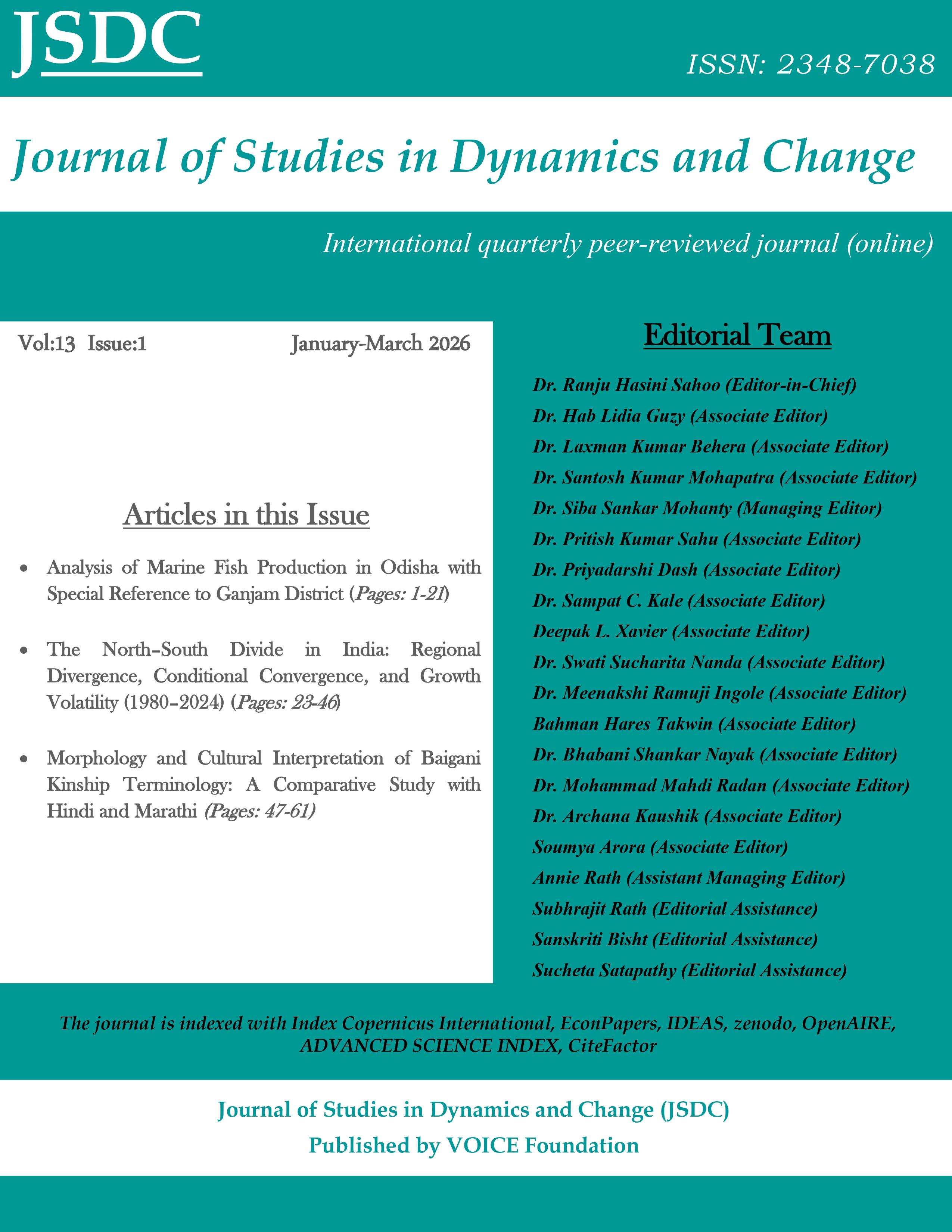
Analysis of Marine Fish Production in Odisha with Special Reference to Ganjam District
Keywords:
Marine Fisheries, Fish Production, District Analysis, Fisheries Economics, Ganjam, OdishaAbstract
In India, marine fisheries are crucial to the creation of jobs, coastal livelihoods, and regional economic growth. Using 24 years of secondary data (2000–01 to 2023–24), the current study examines the development and trend of marine fish production in Odisha with particular reference to Ganjam district. To investigate production trends by district, the study uses quantitative methods such growth rate analysis, Compound Annual Growth Rate (CAGR), decadal growth analysis, moving averages, ANOVA, and correlation analysis. The findings show that Odisha's overall marine fish production rose by almost 87% throughout the course of the research, demonstrating consistent sectoral growth. The results, with particular reference to Ganjam district, reveal an impressive rise of almost 253%, the greatest of the coastal districts, with a CAGR of 5.64%, far higher than the state average (2.77%). While correlation analysis reveals a close relationship between Ganjam's production trends and those of other major fishing districts, the ANOVA results suggest statistically significant differences in production between districts. The study comes to the conclusion that Ganjam's quick development has been facilitated by advancements in fishing infrastructure, mechanization, institutional support, and fisheries policies. In order to promote sustainable marine fisheries development, the report emphasizes the significance of district-level fisheries planning and recommends specific infrastructure, technology, and cooperative strengthening strategies.
References
Allison, E. H., & Ellis, F. (2001). The livelihoods approach and management of small-scale fisheries. Marine Policy, 25(5), 377–388.
Ayyappan, S., & Diwan, A. D. (2006). Fisheries development in India. Fishing Chimes, 26(1), 10–17.
Bavinck, M., Jentoft, S., & Scholtens, J. (2018). Fisheries as social struggle: A reinvigorated social science research agenda. Marine Policy, 94, 46–52.
Box, G. E. P., & Jenkins, G. M. (1976). Time series analysis: Forecasting and control. Holden-Day.
Central Marine Fisheries Research Institute (CMFRI). (2016). Marine fisheries census. CMFRI.
Central Marine Fisheries Research Institute (CMFRI). (2020). Annual marine fish landings in India. CMFRI.
Central Marine Fisheries Research Institute (CMFRI). (2022). Marine fish landings report. CMFRI.
Dash, M., Pradhan, B., & Sethi, N. (2020). Growth trends in the fisheries sector of Odisha. Indian Journal of Fisheries Economics, 12(2), 45–58.
Department of Animal Husbandry & Fisheries. (2021). Annual fisheries report. Government of India.
Department of Fisheries, Government of Odisha. (2022). Fisheries statistics of Odisha. Government of Odisha.
Devaraj, M., & Vivekanandan, E. (1999). Marine fish production trends in India. CMFRI Bulletin, 45.
FAO. (2020). The state of world fisheries and aquaculture. Food and Agriculture Organization.
FAO. (2022). The state of world fisheries and aquaculture 2022. Food and Agriculture Organization.
Government of India. (2022). Pradhan Mantri Matsya Sampada Yojana report. Ministry of Fisheries.
Government of India. (2023). Handbook on fisheries statistics. Ministry of Fisheries.
Gujarati, D. N. (2012). Basic econometrics (5th ed.). McGraw Hill.
Harvey, A. C. (1990). Forecasting, structural time series models and the Kalman filter. Cambridge University Press.
Hilborn, R., et al. (2020). Effective fisheries management instrumental in improving fish stock status. Proceedings of the National Academy of Sciences, 117(4).
ICSF. (2019). Small-scale fisheries report. International Collective in Support of Fishworkers.
Jentoft, S. (2000). Legitimacy and fisheries management. Marine Policy, 24(2), 141–148.
Kumar, R., & Prakash, S. (2017). Fisheries development and regional growth. Economic Affairs, 62(3), 473–480.
Kurien, J. (2005). Responsible fish trade and food security. FAO Fisheries Technical Paper.
Mohanty, B. (2015). Fisheries development in Odisha. Orissa Economic Journal, 47(1).
Myrdal, G. (1957). Economic theory and underdeveloped regions. Duckworth.
National Fisheries Development Board. (2020). Fisheries development in India. NFDB.
North, D. C. (1990). Institutions, institutional change and economic performance. Cambridge University Press.
OECD. (2021). Rebuilding fisheries: The way forward. OECD Publishing.
Panda, S., & Sahu, N. (2021). District-wise fisheries growth analysis. Indian Economic Review, 56(2).
Pauly, D., & Zeller, D. (2016). Catch reconstructions reveal global fisheries trends. Nature Communications.
Rao, K., Sathiadhas, R., & Najmudeen, T. (2018). Fisheries economics in India. Indian Journal of Fisheries.
Sahoo, D., & Mishra, P. (2018). Marine fisheries of Odisha. Journal of Coastal Development.
Salagrama, V. (2012). Climate change and fisheries. FAO.
Schumpeter, J. A. (1934). The theory of economic development. Harvard University Press.
Solow, R. M. (1956). A contribution to the theory of economic growth. Quarterly Journal of Economics, 70(1), 65–94.
Tripathy, S., & Barik, R. (2019). Growth analysis of the fisheries sector. Agricultural Economics Research Review.
Vivekanandan, E., et al. (2009). Climate change impacts on marine fisheries. Current Science.
World Bank. (2012). Hidden harvest: The global contribution of fisheries to development. World Bank.
World Bank. (2017). The blue economy: Sustainable development of ocean resources. World Bank.
Downloads
Published
How to Cite
Issue
Section
License
Copyright (c) 2026 Journal of Studies in Dynamics and Change (JSDC)

This work is licensed under a Creative Commons Attribution-NonCommercial-ShareAlike 4.0 International License.
Readers and users of the Journal of Studies in Dynamics and Change (JSDC) are free to Share — copy and redistribute the papers published in the journal in any medium or format. However, the user (1) must give appropriate credit, provide a link to the license, and indicate if changes were made. (2) May not use the material for commercial purposes (3) Must distribute your contributions under the same license as the original if any remix, transform, or build upon the material is done.